
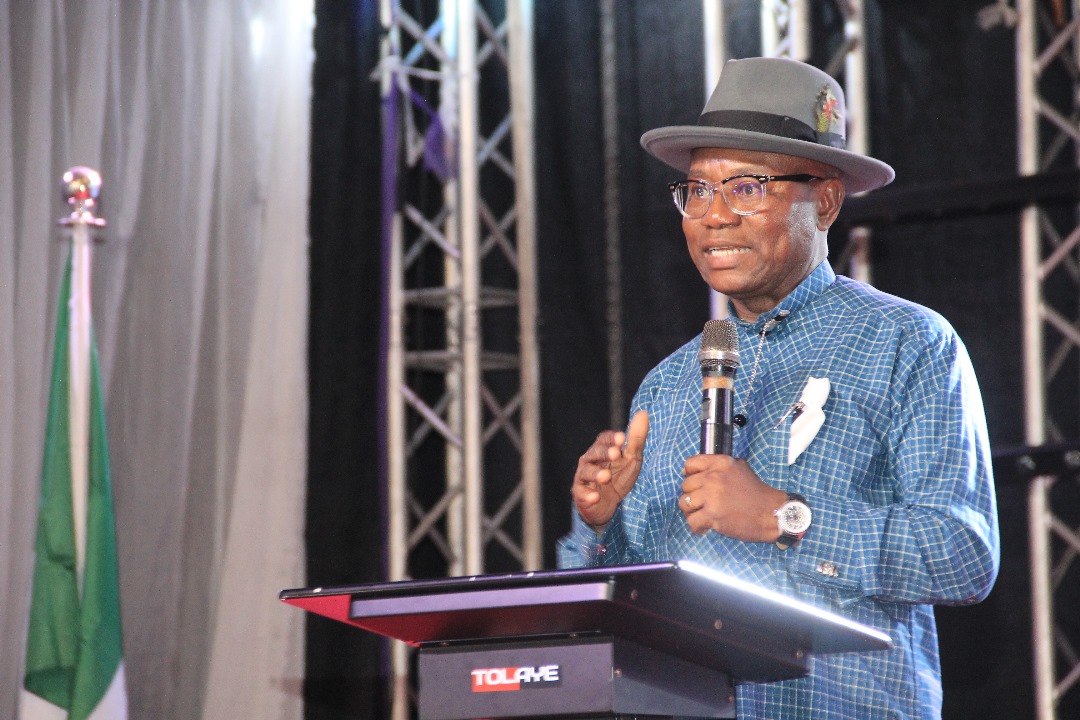
A Presentation at the Niger Delta Business Roundtable: “Creating a New Development Agenda for the Niger Delta Region” with a Strategic Focus on Rivers State.
Introduction
The Oil Rivers Protectorate in the Niger Delta, part of the Niger Coast Protectorate, in 1893 merged with the Royal Niger Company (a colonial trading company) and its chartered territories to form the Southern Nigeria Protectorate, which ultimately amalgamated with the Northern Nigeria Protectorate to form the present day Nigeria in 1914.
The true Niger Delta, (most of which are in the South-South Nigeria) is the delta of the River Niger, sitting directly on the Gulf of Guinea, in the Atlantic in Nigeria. A densely populated region with creeks, rivers and mangroves and has Rivers State as its headquarters.
Thus from the beginning, the Niger Delta people thrived on trade and commerce driven by the Royal Niger Company (and later United African Company - UAC, etc) and the natives living along the coast especially Bonny, Brass, Abonnema, Sapele, Forcados, Warri, Calabar etc., supported by inland maritime trade bringing in timber and agricultural produce.
This occurred because the early explorers and colonialists were unsure of the reception of the inter-land communities and because the inland creeks and rivers were uncharted territories hence unsafe for their ships.
In 1913, colonial Britain founded and set up Port Harcourt, a port city and capital of old and present day Rivers State, Nigeria, to export, in addition to agro produce, coal, which was newly discovered in Udi, Enugu State in 1909. A cosmopolitan, well planned commercial, shipping hub named after the then Secretary of State for the Colonies, Mr. Lewis Harcourt.
Yesterday
In 1956, crude oil was discovered in Oloibiri near Port Harcourt and in 1958 commercial crude oil exports commenced in Port Harcourt thus accentuating the economic boom of the Niger Delta area; most of which are also crude oil and gas producing.
The post Nigerian civil war military governments of the 1970s changed the political structure of Nigeria to its near unitary form of government, with concentration of power to the central national government. This led to decline of infrastructure, the economy and other developments in the oil producing Niger Delta, with crude oil deposits rich land, acquired from the communities and allocated sometimes arbitrarily to certain individuals and companies, mostly from outside the Niger Delta. In spite of all, crude oil and natural gas exports accounted for over 90% of the nation’s foreign exchange earnings and 75% of its income.
The sad declining situation continued until about the mid-2000s when militant youths agitation and general insecurity took center stage in the whole Niger Delta, with attendant destruction of oil installations and kidnapping of first oil workers and later, even non oil workers. These actions subsequently degenerated to crude oil theft and other forms of criminal vices which grossly affected the nation’s crude oil production and foreign exchange earnings and has now spread to most parts of the country. With the Federal Government Amnesty and other interventional programs, the security situation in the Niger Delta has substantially been arrested. From the onset the international oil companies’ initial approach to appease and “settle” the youths and some vocal adults in order to operate peacefully and freely in the various oil producing Niger Delta localities instead of human and physical development, though gave some initial respite, but has now ingrained rent seeking and entitlement mentality in the people. The attitude has become a norm and had thus, led not only to the relocation of some businesses out of the Niger Delta, but denied the people, of new projects like the Dangote Refinery that is today being sited in a non significant oil producing Lagos State. It is a known fact that investments capital is cowardly and stays away from problem areas. It’s thus obvious that enterprise revival and development in the oil producing Niger Delta, hold the key to socio-economic stability and growth of the area.
As the Chinese saying goes "Give a man fish, and you feed him for a day. Teach a man to fish, and you feed him for a lifetime", in other to achieve an enduring respite for all.
Today
Even when the security challenges in the Niger Delta states are much better than most parts of the country, perception of insecurity and uncontrollable local communities’ harassment, including some local government areas remain sore points. Other challenges to investors include multiple taxation, formal and informal, some with forceful collection tactics. Issues of land acquisition and title registration remain slow and tedious. Funding and support from government ministries, departments, and agencies are often not available. From about 2012 to date the news often dished out about Rivers State has been that of strong political antagonistic rhetorics, thuggeries and fights. Its little surprising therefore to see most parts of the Niger Delta, lagging behind in many socio-economic indices in comparison to Lagos and even Abuja and Abeokuta, despite the abundance of natural resources, oil and gas, large fertile lands, coastline and rivers, sea ports, airports and many tertiary institutions among others.
Comparison Analysis; Rivers & Lagos 2025
Feature | Rivers State | Lagos State
Foreign Investment Inflow | Recorded Zero capital importation in early 2024/2025 cycles. | Led with $4.6 billion in foreign capital (2024).
GDP 2025 | $17.8 Billion | Approx. $102 billion
GDP 2010 | Approx. $19.27 billion | $80.6 Billion
Revenue Dependence | Historically 70% to 80% dependent on Federation Account/Oil. | Strong Internally Generated Revenue (IGR) independence.
Resource Status | Major oil producer with new 2026 hydrocarbon discoveries. | Diversified: Tech, Finance, and Manufacturing, Services etc
Budget of Rivers State 2010: $1.21 Billion | Budget of Lagos State 2010: $2.74 Billion
The Way Forward
While we commend the Niger Delta Development Commission in the various and numerous infrastructural development of the Niger Delta, the different tiers of government needs to show strong political will to reverse the negative trend.
1. They must be intentional to tell our stories. That we are open for business and tourism. With years of reporting insecurity and conflicts there’s been relatively very few stories of the positive sides and tackling of any remaining negative issues. This need to be done in social and mainstream media. Perception has wiped out any form of positive realities and investors even local ones will shy away from the Niger Delta.
2. Rein in, local community leaders and the menacing thugs. They constitute nuisance to everyone especially entrepreneurs and investors.
3. Massive infrastructural development-While Rivers State and other Niger Delta State should focus on relevant infrastructure the regional economic block, the BRACED Commission which has been dormant need to be revived to align and augment the efforts of the NDDC. Connectivity, good roads, especially the East West road completion and internal extentions should be priotise. Also air and rail connectivity in the Niger Delta is critical,worthy to note is the need for an economic triangle (PH-ABA-UYO)or economic quadrangle including (WARRI-PH-ABA-UYO)
4. Governments Aggressive and intentional support for entreprenures and industrilization through PPPs, setting up of industrial parks and Special Economic Zones to promote investments in the region, remains paramount.
5. Government should encourage local and international events in the state, including sporting, social, conferences. This will not only support micro and small business within the period but visitors can then know the difference between perception and reality. Afterall seeing is believing
Conclusion
We have a choice in 2026. We can continue to be a region that 'produces' wealth for others to spend in Lagos and Abuja, or we can become a region that 'protects' wealth so our own children can build here. The 'New Agenda' isn't a document; it's a decision to stop being an ATM for the nation and start being an Engine for the region.
Share this Insight

Dr. Emi Membere-Otaji, MD, OON
Solcom Investment Limited
Driving strategic growth and delivering premium estate development solutions with over a decade of industry expertise.